
CT Scan vs. MRI: Which Imaging Test Is Right for Your Condition?
When your doctor recommends advanced imaging, it’s common to wonder why a particular test was selected. Two of the most frequently used imaging exams are CT scans and MRI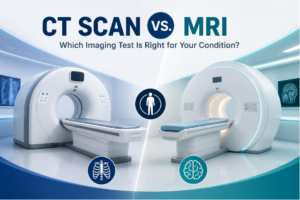 scans. While both provide detailed views of structures inside the body, they use different technologies and are often chosen for different clinical situations.
Understanding the differences between CT and MRI can help patients feel more informed about their care and better understand the reasoning behind their physician’s recommendation.
The most important thing to remember is that neither test is universally “better.” Each has unique strengths, and the appropriate choice depends on the medical concern being evaluated.
What Is a CT Scan?
A CT (computed tomography) scan uses X-rays and advanced computer processing to create detailed cross-sectional images of the body.
During the exam, the scanner captures multiple images from different angles. A computer then combines those images into highly detailed views of:
- Bones
- Internal organs
- Blood vessels
- Soft tissues
CT scans are known for being fast, efficient, and highly effective for evaluating a wide range of medical conditions.
What Is an MRI?
MRI stands for magnetic resonance imaging.
Unlike CT scans, MRI uses powerful magnets and radio waves to generate detailed images. MRI is particularly effective for evaluating soft tissues and structures such as:
- The brain
- The spinal cord
- Muscles
- Tendons
- Ligaments
- Joints
- Certain internal organs
Because MRI does not use ionizing radiation, it may be preferred in certain situations depending on the patient’s condition and clinical needs.
How the Technologies Differ
Although both exams create detailed internal images, the technology behind them is very different.
CT Scan
- Uses X-rays
- Produces cross-sectional images quickly
- Often completed within minutes
- Excellent for visualizing bones and many internal structures
MRI
- Uses magnetic fields and radio waves
- Typically requires more imaging time
- Provides exceptional soft tissue detail
- Useful for evaluating many neurological and musculoskeletal conditions
The choice between the two depends on what your physician needs to see.
When a CT Scan May Be Recommended
CT scans are commonly used when physicians need rapid, detailed imaging. Examples include:
- Evaluating injuries after an accident
- Investigating abdominal pain
- Assessing chest conditions
- Examining certain vascular concerns
- Evaluating kidney stones
- Monitoring some medical conditions
- Supporting oncology imaging and follow-up care
Because CT scans are fast and versatile, they are frequently used in both outpatient and emergency settings.
When an MRI May Be Recommended
MRI is often selected when detailed soft tissue evaluation is needed. Physicians may recommend MRI for:
- Brain imaging
- Spine evaluations
- Suspected ligament injuries
- Tendon injuries
- Joint abnormalities
- Certain neurological symptoms
- Soft tissue conditions
MRI can often provide information that may not be as clearly visible on CT imaging.
Which Exam Is Better for Bones?
When evaluating many bone-related concerns, CT imaging often provides exceptional detail. CT scans may be used to assess:
- Complex fractures
- Bone injuries
- Certain skeletal abnormalities
- Trauma-related conditions
This is one reason CT imaging is frequently used when detailed visualization of bone structures is needed.
Which Exam Is Better for Soft Tissues?
MRI is often preferred when physicians need highly detailed images of soft tissues. Examples include:
- Ligaments
- Tendons
- Muscles
- Intervertebral discs
- The spinal cord
- Brain tissue
The superior soft tissue contrast provided by MRI can be particularly valuable for evaluating musculoskeletal and neurological conditions.
Are CT Scans Faster Than MRI?
In many cases, yes.
CT scans are generally completed more quickly than MRI examinations. While appointment times vary, the imaging portion of many CT studies may take only a few minutes.
MRI studies often require more time because multiple image sequences are obtained to provide detailed soft tissue information.
The duration of either exam depends on the body part being examined and the specific clinical question.
Do Both Exams Sometimes Use Contrast?
Yes. Depending on the study being performed, either CT or MRI may involve contrast material to improve visualization of certain structures.
Contrast may help physicians evaluate:
- Blood vessels
- Internal organs
- Areas of inflammation
- Certain abnormalities
Your healthcare provider and imaging team will determine whether contrast is appropriate for your examination.
Why Your Doctor Chooses One Over the Other
The decision is based on several factors, including:
- Your symptoms
- The area being examined
- Your medical history
- The clinical question being investigated
- The type of information needed
In some situations, CT is the most appropriate first step. In others, MRI may provide the clearest answers. Occasionally, both studies may be used at different points during the evaluation process.
The goal is always to select the imaging exam most likely to provide useful diagnostic information.
What to Expect During Either Exam
Both CT and MRI are noninvasive imaging studies. During either exam, you will be asked to remain as still as possible while images are obtained.
After the examination:
- A radiologist reviews the images.
- A report is prepared.
- Results are sent to your referring provider.
- Your provider discusses the findings and any next steps with you.
The interpretation of the images is an important part of the diagnostic process and helps guide future care decisions.
CT Scan in Denville, NJ
At ImageCare Radiology, patients seeking a CT scan in Denville, NJ, have access to advanced imaging technology and experienced radiologists dedicated to providing accurate, high-quality diagnostic imaging. CT scans play an important role in evaluating injuries, symptoms, and medical conditions while helping physicians make informed treatment decisions.
Choosing the Right Imaging Exam
CT scans and MRI exams are both powerful diagnostic tools, but they serve different purposes. CT imaging is often valued for its speed and versatility, while MRI is frequently chosen for its exceptional soft tissue detail.
The best imaging study is the one that provides your physician with the information needed to answer a specific clinical question. By understanding how these technologies differ, patients can feel more confident about the role imaging plays in their diagnosis and treatment journey.