
How to Choose Between Upright, Open, and Closed MRI
Not all MRI scans look or feel the same. Each type produces detailed images of soft tissues, joints, and organs; however, the amount of space inside the scanner, the body position required, and the level of comfort can differ significantly. Learn the basics to help you feel more prepared before scheduling your exam.
At ImageCare Radiology in East Brunswick, NJ, patients can access an upright MRI option designed for comfort and natural body positioning.
Callout: Why MRI Types Look So Different
MRI machines vary in shape and structure to meet different patient needs. Some prioritize comfort or openness, while others focus on delivering the highest image clarity.
What Makes an Upright MRI Different
An upright MRI allows you to be scanned while sitting or standing, giving providers a chance to capture images in weight-bearing positions. This can be especially helpful when symptoms appear only when the body is upright.
Advantages of Upright MRI
- Natural positioning: Scanning in real-life postures can reveal issues not visible when lying down.
- More comfort: Ideal for those who have back pain or difficulty lying flat.
- Reduced claustrophobia: The design feels more open than traditional scanners.
- Improved breathing comfort: Many patients appreciate the increased freedom of movement.
Who Benefits Most
- Patients with posture-dependent pain
- Individuals with mobility limitations
- Anyone who feels uneasy in enclosed spaces
Callout: A Helpful Tip for Claustrophobic Patients
Many people who feel anxious in traditional MRI tubes find upright MRI far more comfortable, thanks to better visibility and more open space.
How Open MRI Systems Compare
Open MRI machines are designed with wider openings or open sides, giving patients more breathing room. They still provide reliable diagnostic imaging, though image resolution may differ from high-strength closed systems.
Advantages of Open MRI
- Roomier design: Helpful for larger-bodied patients or those with anxiety.
- Gentler experience for children: The spacious setting can feel less intimidating.
- Lower anxiety levels: Visibility and airflow reduce stress for many patients.
Considerations
- Magnet strength may be lower than in closed MRI systems.
- Certain subtle abnormalities are better captured with higher-strength scanners.
Open MRI offers a great balance between comfort and diagnostic value for many patients.
Closed MRI: The High-Strength Classic
Closed MRI systems are the traditional cylindrical machines that offer the highest magnetic field strength. They often produce the most detailed images, which can be critical for complex cases.
Advantages of Closed MRI
- Exceptional detail: Excellent for detecting small or complex abnormalities.
- Shorter scan times: Stronger magnets often speed up the process.
- Preferred for targeted imaging: Especially useful for neurological, orthopedic, and soft-tissue evaluations.
Considerations
- The tube-like structure can feel tight for some patients.
- Positioning requires lying flat and remaining still.
- Not ideal for claustrophobic individuals unless sedation or calming techniques are used.
Callout: Why Closed MRI Still Matters
Even with newer designs available, closed MRI remains the gold standard for the highest imaging detail, especially when precision is the top priority.
How to Choose the MRI That’s Right for You
Selecting the best MRI depends on your symptoms, comfort needs, and your provider’s imaging goals. You might find this guide helpful: 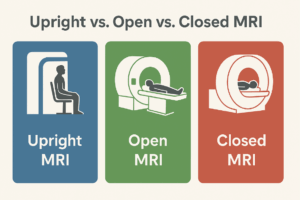
- Choose Upright MRI if symptoms change when standing, you can’t lie flat comfortably, or you prefer the most open environment.
- Choose Open MRI if you want more space, have anxiety in enclosed areas, or need a child-friendly option.
- Choose Closed MRI if your provider needs the highest-resolution images for complex or detailed evaluations.
If you’re still unsure, your healthcare provider can recommend the best match based on your condition and imaging needs.
Quick Comparison at a Glance
| Feature | Upright MRI | Open MRI | Closed MRI |
| Space | Most open | Moderately open | Most enclosed |
| Claustrophobia-Friendly | ✔️ | ✔️ | ⚠️ |
| Image Detail | Good | Good | Excellent |
| Weight-Bearing Imaging | ✔️ | ✖️ | ✖️ |
| Body Position | Sitting/Standing | Lying Down | Lying Down |
| Ideal Use | Posture-related issues | Comfort-focused exams | High-precision needs |
Choosing the MRI Experience That Fits You Best
Upright, open, and closed MRI systems each offer distinct benefits. Upright MRI provides natural positioning and comfort, open MRI delivers spaciousness and ease, and closed MRI supplies the most detailed imaging. Understanding these differences helps you feel informed, confident, and ready for your exam.