
X-Ray vs. MRI: What’s the Difference?
If your doctor says you need imaging, you may wonder why they chose an X-ray instead of an MRI, or why an MRI is being recommended after you already had an X-ray.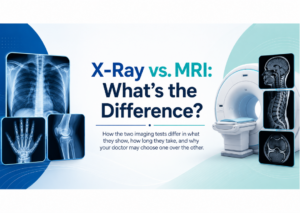
The answer usually comes down to one thing: what your doctor needs to see.
X-rays and MRI scans both create images of the body, but they are useful for different reasons. One is not simply better than the other. Each test has its own strengths, and the right choice depends on your symptoms, the part of the body being examined, and the question your doctor is trying to answer.
What Does an X-Ray Show Best?
X-rays are especially useful for looking at bones and certain joint or chest concerns. Your doctor may order an X-ray to look for:
- Broken bones
- Changes in bone alignment
- Dislocations
- Arthritis-related changes
- Some chest conditions
- Certain bone abnormalities
Because bones show up clearly on X-ray images, this test is often a good first step after an injury or when your doctor suspects a problem involving the skeleton.
What Does an MRI Show Best?
MRI is often used when doctors need a closer look at soft tissues. It can be helpful for evaluating structures such as:
- Ligaments
- Tendons
- Muscles
- Cartilage
- Spinal discs
- The brain
- The spinal cord
MRI uses magnetic fields and radio waves rather than ionizing radiation.
That makes it especially useful for certain injuries and conditions that may not show clearly on a standard X-ray.
Why Might an X-Ray Be Ordered First?
After a fall, twist, or other injury, an X-ray is often one of the first imaging tests considered because it can quickly show whether there is an obvious fracture, dislocation, or change in alignment.
If the X-ray explains the problem, another imaging test may not be needed. If the X-ray looks normal but your symptoms continue, your doctor may decide that more detailed imaging would be useful.
For example, an X-ray may not clearly show a ligament or tendon injury. In that situation, MRI may be considered if the symptoms suggest a soft tissue problem.
Is an MRI Better Than an X-Ray?
Not necessarily. It is more helpful to think of them as tools for different jobs.
If your doctor wants to know whether a bone is broken, an X-ray may provide the answer without the need for a longer exam.
If the concern involves a torn ligament, spinal disc, or another soft tissue structure, MRI may provide more useful detail. Choosing the right test is about getting the information that matters most, not using the most advanced technology every time.
Which Test Takes Longer?
X-rays are generally much quicker.
During an X-ray, a technologist positions the part of the body being examined and takes one or more images. You usually need to stay still only briefly for each picture.
MRI exams tend to take longer because many detailed images are collected during the study. You also need to remain still while those images are being taken.
The exact length of either exam depends on what part of the body is being studied and what your doctor ordered.
Do X-Rays and MRI Feel Different?
Yes. For an X-ray, you may stand, sit, or lie down while a technologist positions you for the necessary images.
MRI usually involves lying on a table that moves into the scanner. The machine can make loud knocking or tapping sounds while images are being collected.
Neither exam should cause pain by itself, although positioning can sometimes be uncomfortable if you are already injured or sore.
Do Both Tests Use Radiation?
No. X-rays use ionizing radiation to create images. MRI does not use ionizing radiation. Instead, it uses a strong magnetic field and radio waves.
That does not mean MRI is automatically the safer or better test for every person. MRI also has its own safety considerations, especially for people with certain implants, devices, or metal in the body.
Before either exam, it is important to answer the imaging team’s safety questions carefully.
What If My X-Ray Is Normal but I Still Have Pain?
A normal X-ray can still be useful information.
It may show that there is no obvious fracture or other bone problem, while also pointing your doctor toward another possible source of pain.
For example, symptoms may come from a ligament, tendon, cartilage, or another soft tissue structure that does not show well on X-ray.
If your symptoms continue, your provider may recommend another type of imaging or a different kind of follow-up.
Do Results Come Back Faster With an X-Ray?
The images from an X-ray are captured quickly, but that does not always mean you will have a final answer right away.
After the exam, a radiologist reviews the images and prepares a report for your referring provider.
The same basic process happens with MRI.
Your provider then considers the imaging findings along with your symptoms, physical exam, and any other test results before deciding what comes next.
Can You Need Both an X-Ray and an MRI?
Yes. Sometimes the two tests answer different parts of the same question.
An X-ray may be used first to look at bones and alignment, while an MRI may be added later if more detail is needed about soft tissues.
Having both does not mean the first test was unnecessary. Each one may contribute different information.
X-Ray in Fair Lawn, NJ
If your healthcare provider recommends an X-Ray in Fair Lawn, NJ, ImageCare Radiology offers diagnostic X-ray imaging for injuries, joint concerns, chest symptoms, and other medical needs.
X-ray imaging can give your referring provider a useful first look at bones and certain other structures and help determine whether another type of imaging may be needed.
The Right Test Depends on the Question
X-rays and MRI scans are both valuable, but they are designed to answer different questions.
An X-ray may be the right choice when your doctor needs a quick look at bones or certain joint or chest concerns. MRI may be more useful when the problem involves soft tissues or requires more detailed imaging.
The goal is not to choose the most complicated test. It is to choose the one that gives your doctor the information needed to understand what may be causing your symptoms and what should happen next.