
X-Ray vs. CT Scan: What’s the Difference?
How the two imaging tests differ in detail, speed, and the kinds of questions they help doctors answer.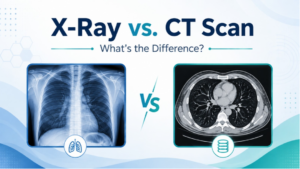
If your doctor says you need imaging, you may wonder why they ordered an X-ray instead of a CT scan, or why a CT is needed after you already had an X-ray.
Both tests use X-rays, but they create very different kinds of images.
A standard X-ray gives a quick, two-dimensional view of the area being examined. A CT scan takes many X-ray images from different angles and combines them into detailed cross-sectional pictures.
The best choice depends on what your doctor needs to see.
What Is an X-Ray Used For?
Standard X-rays are especially useful for looking at bones, joints, and certain areas of the chest. Your doctor may order one to look for:
- A possible fracture
- A dislocation
- Changes in joint alignment
- Arthritis-related changes
- Certain chest conditions
- Some bone abnormalities
Because the images can be taken quickly, X-rays are often a useful first step when the concern is something they are well suited to show.
What Is a CT Scan Used For?
A CT scan provides much more detail than a standard X-ray.
Instead of looking at one flat image, doctors can review thin cross-sectional views of the body. This can make it easier to see structures that overlap on a regular X-ray.
CT may be used to evaluate:
- More complex fractures
- Internal injuries
- The chest, abdomen, or pelvis
- Certain blood vessel concerns
- Kidney stones
- Some infections
- Tumors or other internal abnormalities
The exact reason for the scan depends on your symptoms and what your provider is trying to understand.
Why Might Your Doctor Order an X-Ray First?
Sometimes an X-ray can answer the question without the need for a more detailed test.
For example, if your doctor suspects a simple fracture, a standard X-ray may provide enough information to confirm what happened and guide treatment.
If the X-ray does not fully explain your symptoms, or if the injury is more complex, CT may be recommended for a closer look.
Starting with the simpler test can make sense when it is likely to provide the information your doctor needs.
When Is a CT Scan More Helpful?
CT becomes more useful when doctors need to see smaller details or structures that are difficult to separate on a standard X-ray.
For example, CT may help show:
- A complicated fracture with several bone fragments
- Internal bleeding after trauma
- Detailed lung or abdominal findings
- Structures hidden behind other tissues on a regular X-ray
That added detail can be valuable, especially when the clinical question goes beyond what a standard X-ray can show clearly.
Does a CT Scan Use More Radiation?
Yes. Both X-rays and CT scans use ionizing radiation, but CT generally involves more radiation because many images are collected during the scan.
That does not mean CT should be avoided when it is medically necessary. Your healthcare provider weighs the benefit of getting detailed information against the radiation exposure.
The goal is to use the test that gives the needed information without doing more imaging than necessary.
Which Test Is Faster?
Standard X-rays are usually very quick.
A technologist positions the part of your body being examined and takes one or more images from the angles your doctor requested.
CT scans are also relatively fast, but the process is a little more involved. You lie on a table that moves through the scanner while images are collected.
The total appointment time for either exam can vary depending on the area being studied and whether any additional preparation is needed.
Do X-Rays and CT Scans Feel Different?
Yes. For an X-ray, you may stand, sit, or lie down while the technologist positions you for each image. For a CT scan, you usually lie on a table that moves through a large, ring-shaped scanner.
Neither exam should hurt on its own, although positioning may be uncomfortable if you are already injured or in pain.
Some CT exams also use contrast material, depending on what your doctor needs to see.
What If My X-Ray Is Normal but I Still Have Symptoms?
That can happen.
A standard X-ray may not show every type of injury or internal problem. If your symptoms continue or your doctor still has concerns, CT or another imaging study may be considered.
A normal X-ray can still be useful because it may rule out certain problems and help narrow down what should be looked at next.
Is a CT Scan Always Better Because It Shows More Detail?
No. More detail is helpful only when that detail is needed.
If a standard X-ray can answer the question, a CT scan may not add enough useful information to justify the additional radiation.
Your provider chooses the exam based on your symptoms, the body part involved, and the type of information needed to make the next decision.
What Happens After the Exam?
After either test, a radiologist reviews the images and prepares a report for your referring provider.
Your provider will then consider the imaging results together with your symptoms, physical exam, and any other testing.
Depending on what the images show, you may need treatment, follow-up, or another type of imaging.
X-Ray in Hackettstown, NJ
If your healthcare provider recommends an X-ray in Hackettstown, NJ, ImageCare Radiology offers diagnostic X-ray imaging for injuries, joint concerns, chest symptoms, and other medical needs.
X-ray imaging can provide a useful first look and help your provider determine whether additional imaging may be needed.
Understanding Why One Test May Be Chosen Over Another
X-rays and CT scans both have important roles in medical imaging.
A standard X-ray is often a good place to start when the concern involves bones, joints, or certain chest conditions. CT can provide a more detailed look when the situation is more complex or when your doctor needs to see deeper structures.
Knowing what each test is designed to show can make it easier to understand why your doctor chose one and what they hope to learn from the results.