
CT Scan, Ultrasound, or MRI? Understanding Your Imaging Options
If your doctor recommends medical imaging, you may wonder why one test is chosen over another. Why would one patient receive a CT scan while another undergoes an ultrasound or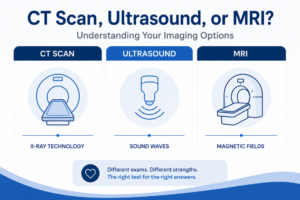 MRI?
The answer depends on the specific health concern being evaluated. Each imaging modality provides different types of information, and each has unique strengths that make it useful in certain situations.
Understanding the differences between CT scans, ultrasounds, and MRIs can help patients feel more informed about their care and better understand why a particular exam may be recommended.
Why Different Imaging Tests Exist
No single imaging exam can answer every medical question.
Different imaging technologies allow physicians to evaluate different parts of the body and gather different types of information.
When choosing an imaging study, providers consider factors such as:
- The symptoms being investigated
- The body part being examined
- The level of detail needed
- Whether the situation is urgent
- The patient’s medical history
The goal is always to select the imaging exam that can provide the most useful diagnostic information.
What Is a CT Scan?
A CT (computed tomography) scan uses X-rays and computer technology to create detailed cross-sectional images of the body.
Unlike traditional X-rays, CT scans provide multiple views that allow physicians to see structures in greater detail.
CT Scans Are Often Used For:
- Traumatic injuries
- Fracture evaluation
- Internal bleeding
- Lung conditions
- Abdominal pain
- Certain cancers
- Vascular conditions
One of the major advantages of CT imaging is speed. Many scans can be completed in just a few minutes, making CT particularly valuable in emergency and urgent-care situations.
What Is an Ultrasound?
Ultrasound uses sound waves to create real-time images of structures inside the body. Unlike CT scans and X-rays, ultrasound does not use ionizing radiation.
Ultrasound Is Commonly Used For:
- Pregnancy imaging
- Gallbladder evaluation
- Thyroid imaging
- Pelvic imaging
- Blood vessel assessment
- Soft tissue evaluation
Ultrasound is especially useful for evaluating organs and tissues that can be visualized effectively with sound waves. Because it provides real-time imaging, it is also commonly used to guide certain medical procedures.
What Is an MRI?
MRI (magnetic resonance imaging) uses powerful magnets and radio waves to create highly detailed images of internal structures.
MRI is particularly effective at evaluating soft tissues that may not be as clearly visualized with other imaging methods.
MRI Is Often Used For:
- Brain imaging
- Spine evaluation
- Joint injuries
- Ligament and tendon injuries
- Musculoskeletal conditions
- Certain neurological disorders
MRI provides exceptional soft tissue detail, which makes it valuable for diagnosing a wide range of conditions.
Comparing CT Scan, Ultrasound, and MRI
| Feature | CT Scan | Ultrasound | MRI |
| Uses Radiation | Yes | No | No |
| Uses Sound Waves | No | Yes | No |
| Uses Magnetic Fields | No | No | Yes |
| Exam Speed | Typically very fast | Usually fast | Often longer |
| Best For | Bones, organs, trauma, lungs | Soft tissues, blood flow, pregnancy | Detailed soft tissue imaging |
| Real-Time Imaging | No | Yes | No |
Each modality provides different information, which is why they are often complementary rather than interchangeable.
Why Your Doctor May Recommend a CT Scan
A physician may recommend a CT scan when detailed internal images are needed quickly. For example, CT imaging is frequently used to evaluate:
- Sudden abdominal pain
- Suspected appendicitis
- Kidney stones
- Chest conditions
- Traumatic injuries
- Certain cancers
CT scans often provide a comprehensive view of multiple structures at the same time.
Why Your Doctor May Recommend an Ultrasound
Ultrasound may be preferred when evaluating:
- Pregnancy
- Gallbladder concerns
- Pelvic symptoms
- Thyroid abnormalities
- Blood vessel conditions
Because ultrasound does not use radiation and provides real-time imaging, it is often an excellent first-line diagnostic tool for many conditions.
Why Your Doctor May Recommend an MRI
MRI may be selected when highly detailed soft tissue imaging is needed. Common reasons include:
- Persistent joint pain
- Sports injuries
- Back and neck problems
- Brain and neurological symptoms
- Evaluation of muscles, tendons, and ligaments
Although MRI exams generally take longer than CT scans, they often provide exceptional anatomical detail.
Can Patients Choose Which Exam They Want?
Many patients ask whether they can simply request a different imaging study. In most situations, imaging recommendations are based on the specific medical question that needs to be answered.
While patients should always discuss concerns and preferences with their healthcare provider, one imaging modality is not automatically interchangeable with another.
An MRI may provide information that a CT scan cannot. Likewise, a CT scan may answer a question that ultrasound cannot adequately address.
The best imaging study is the one most appropriate for the clinical situation.
CT Scan in Middletown, NJ
At ImageCare Radiology, patients seeking a CT scan in Middletown, NJ, have access to advanced imaging technology and experienced radiologists who work closely with referring providers to support accurate diagnosis and treatment planning.
Learn more about CT imaging services at ImageCare Radiology:
The Right Test for the Right Situation
CT scans, ultrasounds, and MRIs all play important roles in modern healthcare. Rather than competing technologies, they are complementary tools that help physicians gather the information needed to make informed decisions.
Understanding the strengths of each imaging modality can help patients feel more confident when an exam is recommended. Whether evaluating an injury, investigating symptoms, or monitoring a medical condition, the right imaging study can provide valuable answers and help guide the next steps in care.