
Common Reasons Your Doctor May Recommend a CT Scan
If your doctor has ordered a CT scan, you may be wondering why this particular imaging exam was recommended. CT scans are among the most versatile diagnostic tools available,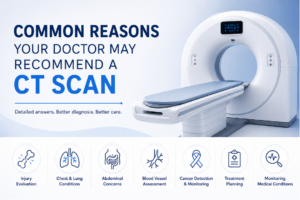 providing detailed images that help physicians evaluate many different parts of the body.
While not every medical concern requires advanced imaging, there are situations where a CT scan can provide information that may not be visible through a physical examination, laboratory testing, or standard X-rays alone.
Understanding why CT scans are used can help patients feel more informed about the role imaging plays in the diagnostic process.
What Is a CT Scan?
A CT (computed tomography) scan combines X-ray technology with advanced computer processing to create detailed cross-sectional images of the body.
Rather than producing a single image like a traditional X-ray, a CT scan captures multiple images from different angles. These images are then reconstructed into highly detailed views of internal structures.
CT scans can help physicians evaluate:
- Bones
- Internal organs
- Blood vessels
- Soft tissues
- Certain areas of the brain and spine
Because CT imaging provides a comprehensive look at many parts of the body, it is used in a wide range of medical situations.
Evaluating Injuries After an Accident
One of the most common reasons physicians order CT scans is to evaluate injuries following trauma. A CT scan may help physicians assess internal structures and determine whether further treatment is needed after events such as:
- Falls
- Motor vehicle accidents
- Workplace injuries
- Sports-related injuries
CT imaging is particularly valuable when detailed information is needed quickly.
Investigating Persistent or Unexplained Symptoms
Sometimes symptoms continue despite an initial medical evaluation.
Depending on the situation, a physician may recommend a CT scan to gather additional information when investigating concerns such as:
- Persistent abdominal pain
- Ongoing headaches
- Unexplained chest discomfort
- Chronic sinus issues
- Unexplained swelling
The goal is not simply to identify abnormalities, but also to help rule out certain conditions and narrow the list of possible causes.
Assessing Abdominal and Pelvic Concerns
CT scans are frequently used to evaluate symptoms involving the abdomen and pelvis. A physician may order imaging when investigating:
- Severe abdominal pain
- Suspected appendicitis
- Kidney stones
- Certain digestive concerns
- Unexplained pelvic symptoms
The detailed images provided by CT technology can help physicians better understand what may be contributing to a patient’s symptoms.
Evaluating Lung and Chest Conditions
CT scans can provide highly detailed images of the lungs and chest. Depending on the clinical situation, CT imaging may be used to evaluate:
- Persistent respiratory symptoms
- Certain lung abnormalities
- Chest injuries
- Follow-up imaging recommendations
- Specific findings identified on a chest X-ray
Because CT imaging offers greater detail than standard X-rays, it is often used when additional information is needed.
Examining Blood Vessels
Certain CT studies are designed to evaluate blood vessels throughout the body. These exams may help physicians assess:
- Blood flow
- Vascular anatomy
- Certain circulatory concerns
When clinically appropriate, contrast material may be used to improve visualization of blood vessels and surrounding structures.
Helping Diagnose and Monitor Certain Cancers
CT scans play an important role in many aspects of oncology care. Depending on the patient’s situation, CT imaging may be used to:
- Investigate concerning findings
- Assist with diagnosis
- Evaluate treatment response
- Monitor changes over time
- Support follow-up care
It’s important to note that a CT scan alone does not determine a cancer diagnosis. Imaging findings are interpreted alongside medical history, physical examinations, laboratory results, and, when necessary, additional testing.
Guiding Treatment Decisions
In many cases, a CT scan helps physicians make more informed treatment decisions. The information obtained through imaging may help determine:
- Whether additional testing is needed
- If a referral to a specialist is appropriate
- Which treatment options may be considered
- How a condition is responding to therapy
Accurate imaging can provide valuable insight that supports individualized patient care.
Monitoring Certain Medical Conditions
CT scans are not used only for initial diagnosis. For some patients, physicians may recommend periodic imaging to monitor known conditions and assess changes over time.
Depending on the condition being followed, imaging may help evaluate:
- Disease progression
- Treatment effectiveness
- Recovery after an illness or injury
- Follow-up recommendations
The frequency and type of imaging depend on each patient’s unique clinical situation.
What Happens During a CT Scan?
CT scans are generally fast and noninvasive. During the exam:
- You will lie on a motorized table.
- The table moves through the CT scanner.
- Images are captured from multiple angles.
- You may be asked to hold your breath briefly during certain portions of the scan.
The procedure itself is painless, and many exams are completed within just a few minutes.
CT Scan in Millburn, NJ
At ImageCare Radiology, patients seeking a CT scan in Millburn, NJ, have access to advanced imaging technology and experienced radiologists who provide detailed image interpretation to support accurate diagnoses and personalized treatment planning.
A Versatile Tool for Modern Diagnosis
CT scans help physicians evaluate a wide variety of symptoms, injuries, and medical conditions. From investigating unexplained pain to assessing injuries and supporting ongoing treatment decisions, CT imaging provides detailed information that can help guide patient care.
While every situation is different, a CT scan is often recommended because it offers a clear and comprehensive view of internal structures, helping physicians make more informed decisions and develop the most appropriate plan for each patient.