
What to Expect During Your First CT Scan Appointment
If your doctor has recommended a CT scan, it’s normal to have questions, especially if you’ve never had one before. Many patients wonder what the exam involves, whether it will be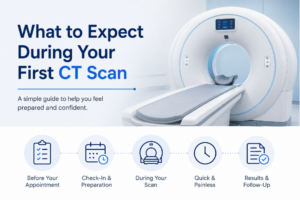 uncomfortable, and how long the appointment will take.
The good news is that CT scans are among the most commonly performed imaging exams and are designed to be fast, efficient, and noninvasive. Understanding what to expect can help ease anxiety and make your appointment feel more manageable.
Whether your physician is investigating symptoms, evaluating an injury, or monitoring a medical condition, a CT scan can provide valuable diagnostic information to help guide your care.
What Is a CT Scan?
A CT (computed tomography) scan uses X-rays and advanced computer technology to create detailed cross-sectional images of the body.
Unlike a traditional X-ray, which produces a single image, a CT scan captures multiple images from different angles. These images are then combined to provide detailed views of bones, organs, blood vessels, and soft tissues.
CT scans are commonly used to evaluate:
- Injuries and trauma
- Abdominal pain
- Chest conditions
- Certain cancers
- Blood vessel abnormalities
- Unexplained symptoms
- Treatment progress and follow-up care
Before Your Appointment
Review Any Preparation Instructions
Preparation requirements vary depending on the type of CT scan being performed. Some exams may require:
- Fasting for a period of time
- Drinking contrast material
- Avoiding certain foods or beverages
- Arriving early for preparation
Other CT scans require little or no special preparation. Following the instructions provided by your healthcare provider or imaging center helps ensure the best possible image quality.
Arrive Early
Most imaging centers recommend arriving before your scheduled appointment time. This allows time for:
- Registration
- Completing paperwork
- Reviewing medical history
- Asking any remaining questions
Arriving early can help your appointment begin smoothly and reduce unnecessary stress.
Share Important Medical Information
Before the exam, you may be asked about:
- Current medications
- Allergies
- Previous reactions to contrast material
- Kidney disease
- Diabetes
- Pregnancy or the possibility of pregnancy
Providing complete and accurate information helps the imaging team determine the safest and most appropriate approach for your exam.
What Happens During Check-In?
Once you arrive, staff members will verify your information and review any preparation requirements. Depending on the type of CT scan, you may be asked to:
- Change into a gown
- Remove jewelry or metal accessories
- Store personal belongings during the exam
The imaging team will explain the process and answer any questions before the scan begins.
Understanding Contrast Material
Some CT scans require contrast material to help certain structures appear more clearly on imaging. Depending on the study, contrast may be:
- Administered through an IV
- Swallowed as a liquid
- Used in another manner specific to the exam
If your CT scan requires contrast, your imaging team will explain what to expect and provide instructions beforehand.
Some patients notice a temporary warm sensation or a metallic taste when IV contrast is administered. These effects are generally brief.
What Does the CT Scanner Look Like?
Many first-time patients are relieved to learn that a CT scanner is not a closed tunnel. The scanner is a large, doughnut-shaped machine with an open center.
A motorized table moves slowly through the opening while images are captured. Because the scanner is relatively open, many patients find the experience more comfortable than they expected.
During the CT Scan
The technologist will position you carefully on the examination table. During the scan:
- The table moves through the scanner.
- Images are captured from multiple angles.
- You may hear soft mechanical sounds.
- You may be asked to hold your breath briefly during certain portions of the exam.
Remaining still is important because movement can affect image quality. The procedure itself is painless.
How Long Does the Appointment Take?
Many patients are surprised by how quickly the imaging portion of a CT scan is completed. While appointment times vary, the actual scan often takes only a few minutes. Additional time may be needed for:
- Registration
- Contrast administration
- Preparation procedures
- Post-scan instructions
Your imaging center can provide more specific timing information based on your examination.
What Happens After the CT Scan?
In most cases, patients can return to their normal daily activities immediately after the exam. If contrast material was used, your healthcare provider may recommend drinking fluids afterward unless other instructions are provided.
The images are then reviewed by a radiologist, a physician specially trained in medical imaging interpretation.
The radiologist prepares a report that is sent to your referring provider, who will discuss the results and any recommended next steps with you.
Common Questions About a First CT Scan
Will the CT scan hurt?
No. CT scans are painless. The most important requirement is remaining still during image acquisition.
Will I be enclosed in a machine?
No. CT scanners are open and doughnut-shaped, allowing the table to move through the center.
Can I drive myself home?
Most patients can drive themselves home and resume normal activities immediately afterward unless instructed otherwise.
How soon will I get my results?
Result timelines vary depending on the exam and your provider’s process, but the radiologist’s report is typically sent to the referring physician for review and discussion.
CT Scan in Morristown, NJ
At ImageCare Radiology, patients seeking a CT scan in Morristown, NJ, have access to advanced imaging technology and experienced radiologists dedicated to providing accurate, high-quality diagnostic imaging in a comfortable outpatient setting.
Confidence Starts with Knowing What to Expect
For many patients, the anticipation of a first CT scan can be more stressful than the exam itself. Understanding the process beforehand can help reduce uncertainty and make the experience feel much more approachable.
From check-in and preparation to image acquisition and result review, each step is designed to help physicians gather the information needed to support accurate diagnoses and informed treatment decisions. With the right preparation and a clear understanding of the process, you can arrive at your appointment feeling informed, prepared, and confident.