Can an MRI Diagnose Alzheimer’s Disease?
What brain imaging can reveal during an evaluation for memory loss and where its limits begin.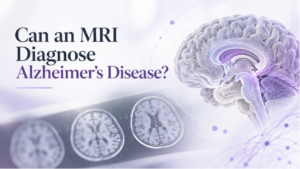
National Alzheimer’s Disease Awareness Month in November brings attention to a condition that often begins with questions. If you or someone close to you is experiencing changes in memory or thinking, one of those questions may be whether a brain scan can provide an answer.
A brain MRI can offer valuable information during an Alzheimer’s evaluation, but it does not provide a stand-alone diagnosis. As the National Institute on Aging explains in its guide to Alzheimer’s diagnosis, doctors use several types of information, which may include medical history, cognitive testing, laboratory tests, neurological evaluation, and brain imaging.
Why Might a Doctor Order an MRI for Memory Loss?
Memory and thinking changes can have many possible causes. MRI gives doctors detailed images of the brain that can help them look for structural changes and other conditions that may be contributing to the symptoms.
For example, imaging can reveal evidence of a stroke, tumor, bleeding, previous injury, or an abnormal buildup of fluid in the brain. Finding one of these problems can provide important information about what may be causing the symptoms and what type of care is needed. The National Institute on Aging’s overview of dementia biomarkers and brain imaging describes MRI as one of the tools physicians may use both to assess brain changes and to look for other possible explanations for memory problems.
What Can Alzheimer’s Look Like on an MRI?
Alzheimer’s disease is associated with gradual loss of brain tissue as the disease progresses. MRI may show shrinkage, or atrophy, in areas involved in memory and thinking.
The hippocampus, a structure that plays an important role in forming memories, is one area that researchers have studied closely. The Alzheimer’s Association’s explanation of structural brain imaging notes that shrinkage in areas such as the hippocampus can occur with Alzheimer’s disease.
Those changes still need context. Brain atrophy can occur with aging and with other neurological conditions, so an MRI finding by itself does not establish that Alzheimer’s is the cause.
Can a Normal MRI Rule Out Alzheimer’s?
A conventional brain MRI cannot rule out Alzheimer’s disease simply because the scan does not show obvious structural changes.
MRI is particularly useful for showing brain anatomy and identifying abnormalities that might contribute to symptoms. The amount of visible structural change varies from person to person and can also depend on how far a disease has progressed.
This is one reason doctors interpret imaging together with cognitive symptoms, medical history, neurological findings, and other testing rather than relying on a scan alone.
How Is Alzheimer’s Disease Diagnosed?
An Alzheimer’s evaluation may include several steps, depending on the person and their symptoms. These can include:
- Medical and family history
- Tests of memory, problem-solving, attention, and language
- Physical and neurological examinations
- Blood or other laboratory testing
- Brain imaging such as MRI or CT
- Biomarker testing when appropriate
Diagnostic testing has continued to evolve. Biomarkers that provide information about Alzheimer’s-related changes in the brain may now play a role in some evaluations, particularly when more certainty is needed about the underlying cause of cognitive symptoms.
What Is the Role of Neuroradiology?
Neuroradiology focuses on imaging of the brain, spine, head, neck, and nervous system. A neuroradiologist is trained to interpret those images and identify structural findings that may be relevant to a patient’s symptoms.
During an evaluation for memory or cognitive changes, that can include looking for patterns of brain-volume loss as well as signs of stroke, a mass, previous injury, or other abnormalities.
ImageCare Radiology’s Neuroradiology and Neuro MRI services include brain imaging used in the evaluation of Alzheimer’s disease, dementia, and other neurological concerns.
Are There Other Types of Brain Imaging for Alzheimer’s?
Yes. MRI is structural imaging, meaning it shows the shape and anatomy of the brain. Other imaging tests can answer different questions.
For selected patients, specialized PET scans can look for amyloid or tau proteins associated with Alzheimer’s disease.
These tests are not routine for everyone with memory changes. Updated Alzheimer’s Association and SNMMI guidance for amyloid and tau PET recommends using them in specific clinical situations where the results may clarify a diagnosis or affect care.
Understanding What a Brain MRI Can Tell You
If your doctor recommends a brain MRI because of memory or thinking changes, the scan can provide useful information about the structure of the brain and help identify findings that may need further evaluation.
It may also help rule out other explanations for the symptoms. What it cannot do on its own is provide a simple yes-or-no answer about Alzheimer’s disease.
Knowing what your doctor hopes to learn from the MRI can make the purpose of the exam clearer and help you understand how the results fit into the larger evaluation.