Juvenile Arthritis Awareness Month: How Pediatric Radiology Helps Evaluate Joint Health
July is Juvenile Arthritis Awareness Month, a time dedicated to raising awareness about arthritis in children and the challenges families may face when navigating symptoms,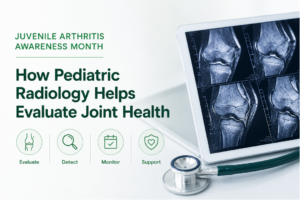 diagnosis, and treatment.
Many people associate arthritis with older adults, but children can develop forms of arthritis as well. In fact, juvenile idiopathic arthritis (JIA) is the most common type of arthritis affecting children and adolescents.
When a child experiences persistent joint pain, swelling, or stiffness, physicians may use several tools to understand what is causing those symptoms. Among them, pediatric radiology plays an important role in evaluating joint health and helping healthcare providers make informed decisions about care.
What Is Juvenile Idiopathic Arthritis?
Juvenile idiopathic arthritis is a group of inflammatory conditions that affect the joints of children under the age of 16.
The exact cause is not fully understood, but JIA is considered an autoimmune disorder, meaning the body’s immune system mistakenly attacks healthy tissues within the joints.
Symptoms can vary from child to child and may include:
- Joint pain
- Swelling
- Stiffness, especially in the morning
- Reduced range of motion
- Fatigue
- Limping or difficulty with physical activities
Some children experience symptoms in a single joint, while others may have multiple joints affected.
When Joint Pain Is More Than Growing Pains
Children often experience occasional aches and pains, especially during periods of growth and physical activity. However, persistent symptoms deserve medical attention. Parents may want to speak with a healthcare provider if a child experiences:
- Ongoing joint pain lasting several weeks
- Swollen joints
- Morning stiffness
- Unexplained limping
- Difficulty participating in normal activities
- Symptoms that repeatedly come and go
While these symptoms do not automatically indicate juvenile arthritis, they may warrant further evaluation.
How Is Juvenile Arthritis Diagnosed?
There is no single test that can definitively diagnose juvenile idiopathic arthritis. Instead, physicians typically consider a combination of:
- Medical history
- Physical examination
- Laboratory testing
- Imaging studies
The goal is to better understand the cause of symptoms while ruling out other conditions that may affect the joints.
This is where pediatric radiology can provide valuable insight.
The Role of Pediatric Radiology in Joint Evaluation
Pediatric radiology focuses on imaging children using techniques designed to meet their unique healthcare needs. When evaluating suspected juvenile arthritis, imaging may help physicians:
- Assess joint inflammation
- Identify structural changes
- Monitor disease progression
- Evaluate treatment effectiveness
- Rule out other causes of joint symptoms
Because children’s bones and joints are still developing, specialized pediatric imaging expertise can be especially important.
Imaging Studies That May Be Used
The type of imaging ordered depends on the child’s symptoms and the information physicians need to gather.
X-Rays
X-rays are often one of the first imaging studies performed when joint symptoms are present. They can help evaluate:
- Bone alignment
- Joint spacing
- Structural abnormalities
- Changes that may occur over time
Although early inflammation may not always be visible on X-rays, they provide valuable baseline information.
Ultrasound
Ultrasound can be useful for evaluating soft tissues and joint inflammation. Because ultrasound provides real-time imaging without radiation, it may help physicians assess:
- Joint swelling
- Fluid accumulation
- Inflammation within and around joints
In some situations, ultrasound can identify findings that are not easily seen during a physical examination.
MRI
MRI provides detailed images of bones, cartilage, soft tissues, and joint structures. For children with suspected juvenile arthritis, MRI may help evaluate:
- Early inflammation
- Joint damage
- Cartilage health
- Soft tissue involvement
MRI is often used when physicians need a more comprehensive view of an affected joint.
Monitoring Joint Health Over Time
Imaging is not used only during the initial evaluation. For some children, pediatric radiology also helps monitor how the condition changes over time.
Follow-up imaging may help physicians:
- Track disease progression
- Assess response to treatment
- Identify complications early
- Support long-term care planning
This information helps healthcare teams tailor treatment strategies to each child’s individual needs.
Supporting Children and Families Through the Diagnostic Process
For parents, uncertainty can be one of the most difficult parts of any medical evaluation. Questions about joint pain, mobility, and long-term health often come with understandable concern.
While imaging alone does not diagnose juvenile arthritis, it provides important information that helps physicians better understand what may be affecting a child’s joints.
The goal is to gather as much accurate information as possible so that children can receive appropriate care and support.
Pediatric Radiology at ImageCare Radiology
At ImageCare Radiology, specialized pediatric radiology services help physicians evaluate a wide range of conditions affecting children, including joint and musculoskeletal concerns. Advanced imaging technology and experienced radiologists provide detailed diagnostic information while prioritizing patient comfort and safety.
Raising Awareness About Juvenile Arthritis
Juvenile Arthritis Awareness Month serves as an important reminder that arthritis can affect children and that persistent joint symptoms should not be ignored.
Through a combination of clinical evaluation, laboratory testing, and pediatric imaging, healthcare providers can gain valuable insight into joint health and develop personalized treatment plans when needed.
For families seeking answers, pediatric radiology is often an important part of the journey toward understanding symptoms, supporting treatment decisions, and helping children stay active and engaged in the activities they love.