Mental Health Month: What Brain Imaging Can and Can’t Tell Us
Each May, Mental Health Month encourages open conversations about emotional well-being, access to care, and the importance of reducing stigma. Mental health is a vital part of overall health, yet it is often misunderstood, especially when it comes to how it relates to the brain.
Because mental health conditions affect how we think, feel, and behave, many people assume that imaging tests can clearly show these conditions. In reality, the relationship between brain imaging and mental health is more nuanced.
This is where neuroradiology comes in. While imaging does not diagnose most mental health conditions, it can still play an important role in helping physicians evaluate symptoms and better understand the brain.
What Is Neuroradiology?
Neuroradiology is a specialized area of radiology focused on imaging the brain, spine, and nervous system. Neuroradiologists use advanced imaging tools, such as MRI and CT scans, to evaluate the structure of the brain and identify abnormalities.
These specialists work closely with neurologists and other healthcare providers to interpret imaging studies and provide insights that support patient care.
Neuroradiology is commonly used to evaluate conditions such as:
- Stroke
- Brain tumors
- Traumatic brain injury
- Structural abnormalities of the brain
- Neurological disorders affecting the brain and spine
What Brain Imaging Can Show
Brain imaging provides detailed views of the brain’s structure. This allows physicians to identify physical changes or abnormalities that may be contributing to symptoms.
Imaging may help detect:
- Evidence of stroke or reduced blood flow
- Brain tumors or masses
- Structural changes in brain tissue
- Signs of injury or bleeding
- Certain neurological conditions
When patients experience symptoms such as sudden confusion, severe headaches, or neurological changes, imaging can help determine whether a physical condition may be present.
What Brain Imaging Cannot Show
While brain imaging is a powerful tool, it has limitations. Most mental health conditions, such as depression, anxiety, or bipolar disorder, are not visible on standard imaging tests.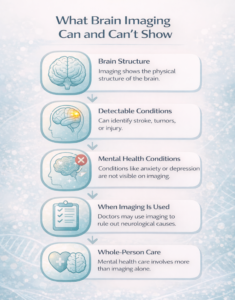
These conditions are typically diagnosed through:
- Clinical evaluation
- Patient history
- Symptom assessment
Imaging does not measure thoughts, emotions, or mood. It cannot directly show conditions that are primarily related to brain chemistry or function rather than structure.
Understanding this distinction is important. It helps set realistic expectations and ensures that imaging is used appropriately as part of a broader evaluation.
When Doctors May Recommend Brain Imaging
Although imaging is not used to diagnose most mental health conditions, it may be recommended in certain situations, particularly when symptoms could be related to an underlying neurological issue.
- A physician may consider imaging if a patient experiences:
- Sudden or severe changes in mental status
- Persistent or worsening headaches
- Memory loss or cognitive decline
- Seizures
- Symptoms that do not respond to standard treatment
In these cases, imaging helps rule out structural causes that may require different medical care.
The Connection Between Brain Health and Mental Health
Mental health and brain health are closely connected, even though they are not always evaluated in the same way. The brain is the organ responsible for regulating mood, behavior, and cognition, which means overall brain health plays a role in how we feel and function.
Neuroradiology contributes to this understanding by helping physicians evaluate the physical structure of the brain and identify conditions that may affect neurological function.
At the same time, mental health care often involves a broader approach that includes therapy, medication, and ongoing support.
A Compassionate Approach to Care
Mental Health Month is a reminder that seeking help is a sign of strength. Whether someone is experiencing emotional challenges, cognitive concerns, or neurological symptoms, a thoughtful and individualized approach to care is essential.
Imaging is one piece of that process. It helps provide clarity when physicians need to better understand what may be happening in the brain, but it works alongside many other tools used in mental health and neurological care.
Raising Awareness During Mental Health Month
As awareness grows, so does the understanding that mental health is complex and deeply personal. There is no single test that provides all the answers, and that includes imaging.
Neuroradiology plays a supportive role, helping physicians evaluate the brain when needed and rule out structural concerns. By combining imaging with clinical expertise and compassionate care, healthcare providers can better support patients on their path to understanding and managing their health.