Physical Therapy Month: When Imaging Can Help
How musculoskeletal imaging can provide useful information about injuries, joint pain, and recovery when a closer look is needed.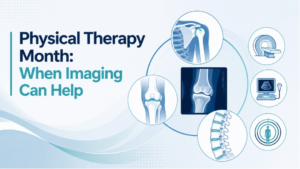
October is National Physical Therapy Month, a time to recognize the role physical therapy can play in helping people move more comfortably, rebuild strength, recover from injuries, and stay active. The American Physical Therapy Association also emphasizes mobility, resilience, prevention, and long-term wellness as important parts of physical therapy.
For many people, that process begins with a conversation about pain, movement, or an injury. Sometimes a physical exam and medical history provide enough information to start treatment. In other situations, a doctor may want a closer look at the bones, joints, or soft tissues before deciding what comes next.
That is where musculoskeletal imaging can be useful.
What Is Musculoskeletal Imaging?
Musculoskeletal imaging focuses on the parts of the body that help you move, including bones, joints, muscles, tendons, ligaments, and other soft tissues.
Depending on the concern, your healthcare provider may recommend an X-ray, MRI, ultrasound, or CT scan. Each exam provides different information.
At ImageCare Radiology, musculoskeletal imaging may be used to evaluate concerns such as fractures, strains, tears, unexplained pain, and other problems involving bones, joints, extremities, and soft tissues.
Do You Need Imaging Before Physical Therapy?
Often, you do not.
Many common muscle and joint problems can be evaluated through your symptoms, medical history, and a hands-on examination. Your provider or physical therapist may be able to begin care without an imaging study when there is no reason to suspect a problem that needs a closer look first.
For example, a straightforward muscle strain may improve with time, activity changes, and appropriate rehabilitation without ever requiring an MRI.
The decision depends on your specific symptoms. Imaging becomes more helpful when the care team needs information that an examination alone cannot provide.
When Can Imaging Be Helpful?
There are several situations where your provider may want additional information before or during your recovery.
A significant fall or accident may raise concern for a broken bone. Ongoing joint pain could lead your doctor to look for arthritis or another structural change. Persistent weakness, swelling, or instability may prompt further evaluation of a tendon, ligament, or other soft tissue.
Imaging may also be considered when symptoms are not improving as expected or when the findings from an examination leave important questions unanswered.
The reason for the scan matters. A useful imaging exam begins with a clear question your healthcare team is trying to answer.
What Can Different Imaging Tests Show?
You may hear several imaging options mentioned during treatment or recovery. They do different jobs.
X-Ray
X-rays are particularly useful for looking at bones. They can help identify fractures, changes in alignment, arthritis, and other bone or joint abnormalities. ImageCare lists X-ray among the imaging methods used within musculoskeletal care.
MRI
MRI gives doctors a detailed view of many soft tissues as well as bones. It may be helpful when the concern involves a ligament, tendon, muscle, cartilage, spinal disc, or another structure that is difficult to see clearly on an X-ray.
Ultrasound
Musculoskeletal ultrasound can provide a closer look at certain tendons, muscles, and other soft tissues. One benefit is that some structures can be examined while they move, which can be useful for particular types of symptoms.
CT
CT creates detailed cross-sectional images and can provide more information about complex bones and anatomy. A doctor may recommend it for certain fractures or other problems where additional detail is needed.
Your provider chooses the exam based on the part of the body involved and the information they need.
How Can Imaging Help During Physical Therapy?
When imaging is appropriate, the results can add context to what you and your physical therapist are already seeing and feeling.
Suppose knee pain began after an injury and MRI shows a ligament problem. That information may help the larger care team understand the extent of the injury and decide whether rehabilitation alone is appropriate or whether another type of treatment should also be considered.
A fracture seen on an X-ray may change when weight-bearing exercise can safely begin. Imaging of persistent shoulder pain may help clarify whether a tendon injury is contributing to the symptoms.
The scan provides another piece of information that can be considered alongside strength, movement, pain, balance, and day-to-day function.
What If Your Imaging Looks Normal but You Still Have Pain?
This is a common and understandable concern.
A normal imaging study does not make your symptoms any less important. Pain is influenced by many factors, and some problems may not create an obvious change on an image.
Your healthcare provider and physical therapist can learn a great deal by looking at how you move, where symptoms occur, what activities make them better or worse, and whether strength or mobility has changed.
If symptoms persist or change, your care team can decide whether further evaluation is appropriate.
Imaging Findings and Symptoms Do Not Always Match Perfectly
Imaging can reveal changes that are important, but the images still need context.
Some people have arthritis or age-related changes visible on a scan and experience very little discomfort. Someone else may have considerable pain even though the imaging findings are relatively minor.
That is why your care team looks at more than the scan. Your symptoms, physical exam, medical history, activity level, and response to treatment all contribute to the decisions made about your care.
Musculoskeletal Imaging at ImageCare Radiology
ImageCare Radiology provides musculoskeletal imaging using MRI, CT, ultrasound, and X-ray to evaluate a range of concerns involving bones, joints, extremities, and soft tissues.
When your healthcare provider decides imaging would be useful, the goal is to provide clear information that can help them better understand the problem and determine the appropriate next step.
Getting the Information You Need to Move Forward
National Physical Therapy Month is a useful reminder of how much goes into helping the body move and function well. Recovery may involve physical therapy, medical evaluation, imaging, or a combination of these depending on the situation.
Musculoskeletal imaging can answer important questions when a closer look is needed. In many other cases, rehabilitation can begin without it.
Understanding why your provider has recommended imaging, or why they have decided it is not necessary yet, can help you feel more informed about the path ahead.