What Brain Imaging Can and Can’t Tell Us About Bipolar Disorder
Every year on March 30th, World Bipolar Day encourages conversations about bipolar disorder, reduces stigma, and highlights the importance of understanding mental health conditions. Bipolar disorder affects millions of people worldwide and is characterized by shifts in mood, energy, and activity levels that can range from depressive episodes to periods of elevated mood or mania.
While bipolar disorder is primarily diagnosed through clinical evaluation, many people wonder whether brain imaging tests like MRI can detect or confirm the condition. The answer is nuanced. Brain imaging does play a role in understanding the brain, but it does not diagnose bipolar disorder on its own.
Understanding what imaging can—and cannot—tell us can help patients and families better navigate conversations about mental health and neurological care.
How Bipolar Disorder Is Diagnosed
Bipolar disorder is diagnosed based on a comprehensive clinical evaluation. Mental health professionals assess symptoms, medical history, mood patterns, and how those patterns affect daily functioning. Diagnostic criteria are established through psychiatric guidelines rather than imaging findings.
Because bipolar disorder involves complex interactions between brain chemistry, genetics, and environmental factors, there is currently no single imaging test that can confirm the condition.
However, imaging may still be used in certain situations during a patient’s medical evaluation.
When Brain Imaging May Be Recommended
In some cases, physicians may recommend brain imaging, such as an MRI, when evaluating symptoms that overlap with neurological conditions.
For example, imaging might be ordered if a patient experiences:
- Sudden changes in behavior or cognition
- New neurological symptoms such as seizures, severe headaches, or vision changes
- Concerns about structural abnormalities in the brain
- Symptoms that require ruling out other medical causes
In these cases, imaging helps physicians look for physical changes in brain structure, tumors, vascular issues, or other neurological conditions that may contribute to symptoms.
This is where Neuro MRI becomes an important diagnostic tool.
What Neuro MRI Can Show About the Brain
A Neuro MRI (neuroradiology MRI) provides detailed images of brain structures using magnetic fields and radio waves. Unlike imaging tests that rely on radiation, MRI produces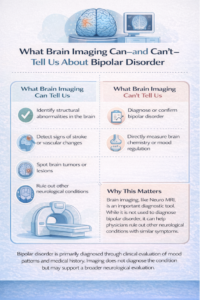 high-resolution images that help physicians examine brain anatomy with precision.
Neuro MRI can help identify:
- Structural abnormalities in the brain
- Signs of stroke or vascular changes
- Brain tumors or lesions
- Inflammation or neurological conditions affecting brain tissue
While these findings may not diagnose bipolar disorder, they can help rule out other medical conditions that might mimic psychiatric symptoms.
What Brain Imaging Cannot Tell Us
Despite advances in neuroscience, imaging cannot currently diagnose bipolar disorder.
Mood disorders involve complex processes such as neurotransmitter activity, brain network function, and emotional regulation. These processes occur on a level that traditional structural imaging cannot directly measure in clinical practice.
Research studies have identified patterns in brain regions associated with mood regulation, including the prefrontal cortex, amygdala, and hippocampus. However, these findings are primarily used to advance scientific understanding rather than to diagnose individual patients.
In other words, brain imaging can offer valuable information about brain health, but it is one piece of a much larger diagnostic picture.
Brain Imaging and Mental Health: What Patients Should Know
Mental health conditions and neurological health are closely connected. While psychiatric diagnoses rely on clinical evaluation, imaging may sometimes be used to support a broader medical assessment.
Patients may encounter brain imaging when physicians want to:
- Rule out neurological causes of symptoms
- Evaluate unexplained changes in cognition or behavior
- Investigate head injuries or neurological disorders
- Support research into how the brain functions in different mental health conditions
Advances in imaging technology continue to improve how researchers study the brain. While imaging does not diagnose most psychiatric conditions, it plays an important role in expanding our understanding of how the brain works.
Neuro MRI at ImageCare Radiology
At ImageCare Radiology, Neuro MRI is used to produce highly detailed images of the brain and nervous system to help physicians evaluate a wide range of neurological conditions.
Our neuroradiology imaging services support referring providers by offering advanced imaging technology and expert interpretation from radiologists experienced in brain and spine imaging.
Supporting Awareness on World Bipolar Day
World Bipolar Day is an opportunity to increase understanding of bipolar disorder and encourage open conversations about mental health. While brain imaging cannot diagnose bipolar disorder, advances in neuroscience and imaging research continue to deepen our understanding of the brain and the conditions that affect it.
By combining thoughtful clinical evaluation with advances in medical science, healthcare providers are continually improving how mental health conditions are recognized, understood, and supported.
Greater awareness leads to better care, and that begins with informed conversations about the brain, mental health, and the tools used to study both.